Wednesday, April 22, 2015

18 Colossal Sea Creatures That Actually Exist

The ocean is an amazing place full of many unusual forms of life. You won't believe the size of these 18 colossal sea creatures. Wait until you see what lurks beneath the ocean's surface.
1) Blue Whale
The blue whale is the largest animal ever known to exist in the world. They are nearly 100 feet (30 m) and weigh a staggering 180 metric tons. The blue whale's heart is the size of a car, just to put things into perspective.
2) Great White Shark
Everyone is familiar with the great white, especially after the 1975 hit film, Jaws. Adult males can grow up to 21 feet (6.4 m) and weigh over 7,000lbs (3,175 kg). They are typically found swimming the waters in South Africa, Mexico and Australia.
3) Giant Oceanic Manta Ray
Ocean mantas can grow over 30 feet (9 m) in width and have a lifespan of about 20 years. They make their home in tropical and subtropical waters, primarily in Thailand.
4) Southern Elephant Seal
These massive creatures are the largest of the seal family, weighing anywhere between 8,800 lbs (4,000 kg), and measuring over 20 feet (6 m) for males. Believe it or not, they actually get their name from their trunk- snouts.
5) Fin Whale
The fin whale is the second largest behind the blue whale. They are more commonly referred to as razorbacks or common rorqual and found in the Northern Atlantic and Southern Hemispheres. Adults grow to reach around 90 feet (27.4 m), with and tip the scales at over 80 short tons (74 metric tons).
6) Whale Shark
If you thought the great white was large, wait until you see the size of its distant relative, the gigantic whale shark. Whale sharks are slow-moving filter feeding sharks. They weigh around 21.5 metric tons and can grow over 42 feet (12.8 m), and are known to pop up throughout the South African waters.
7) Giant Squid
Giant squids are deep-sea dwellers that belong to the Architeuthidae family. These bizarre creatures can grow nearly 60 feet (18.3 m) in size. They are also the largest invertebrates on Earth.
8) Giant Isopod
Giant isopods are members of the crustacean family and a distant relative to shrimp and crabs. Giant isopods measure 30 inches (76 cm) in length and weigh about 3.7lbs (1.7 kg). They are commonly found in the Atlantic and Pacific Oceans.
9) Portuguese Man-of-War
These odd shaped marine mammals are often confused for jellyfish, but they belong to a single multicellular organism family known as siphonophores.Their massive tentacles reach over 165 feet (50 m), despite having relatively small body frames.
10) Sperm Whale
Sperm whales are known for their incredible diving depth when scooping below the ocean floors. They can reach 7,380 feet (2,249 m) below the surface to snack on squid, which is their prey of choice. Adult males can reach 67 feet (20.5 m) as well.
11) Caribbean Barrel Sponge
The giant barrel sponge are nicknamed the "redwood of the reef" due to its long lifespan, which can be up to 2,000 years. They grow at depths that range from 33 feet down (10 m) all the way to 390 feet (120 m) beneath the ocean surface.
12) Giant Oarfish
Giant oarfish can grow up to 36 feet (11 m) in length, despite being nearly palm-size at birth. The massive one seen here was discovered by U.S. servicemen after it had washed up on the San Diego shores of California in 1996. It measured a staggering 23 feet (7 m) in size.
13) Giant Tube Worm
Giant tube worms live several miles deep beneath the Pacific Ocean floors near black smokers (sea vents). They can reach a length of up to 8 feet (2.4 m) and have a very high tolerance for hydrogen sulfide levels.
14) Giant Pacific Octopus
The giant Pacific octopus grows larger than any octopus species and outlives them all. The largest one ever found measured a whopping 30 feet (9.1m) in length and weighed over 600 lbs (272 kg).
15) Lion's Mane Jellyfish
Lion's mane jellyfish is the largest of its species, measuring up to 7.6 feet (2.3 m) in diameter, with tentacles extending beyond 120 feet (37 m). The life- model seen here is on display at the Smithsonian Museum of Natural History in Washington, D.C.
16) Giant Sea Star
The giant sea star might have been the of inspiration for the Sponge Bob Square Pants character of Patrick Star. They are typically found along the western coast of North America and can grow as large as 24 inches (61 cm) in size.
17) Japanese Spider Crab
The Japanese spider crab looks something straight out of a science fiction movie, but it is indeed very real. The massive crab has the record for longest leg span of any living arthropod. They can reach over 12 feet (3.8 m) and weigh upto 42 lbs (19 kg).
18) Giant Clam
The giant clam can grow up to 4 feet (1.2 m) in length, topping the scales at a jaw-dropping weight of 500 lbs (227 kg). They are found at the bottom of the South Pacific and Indian Ocean floors. The giant clam spends the duration of their life cycle attached to one particular spot on a coral reef.

Saturday, April 11, 2015

10 New Animal Species Discovered in 2014

Generally it is considered that the natural world has all been documented by pioneering scientists and travelling adventurers and that there’s nothing new to uncover. It’s exciting to learn that this is not the case and that every year research teams are still unearthing amazing new animal species and plant life. Here are ten of the most notable living species discovered in 2014. 
1. A brightly coloured Outback newcomer
Scientific name: Maratus pardus
This colourful peacock species spider was found in Western Australia and was named Pardus (Latin for leopard) because of its leopard-like spots. It’s also as a tribute to the cat-like movements it makes.
2. An Amazonian toupee monkey
Scientific name: Pithecia isabela
Called Isabel’s saki, these primates look like they’re wearing bad toupees. They were discovered by Laura Marsh, the co-founder of the Global Conservation Institute. These fruit-eating monkeys are acrobatic, live in trees and play an essential role in spreading seeds across the Amazon. 
3. Peruvian spider mystery
This discovery remains a mystery. Graduate student Troy Alexander discovered a strange web formation under a tarp,while volunteering in the Peruvian Amazon. This discovery has stumped experts and after much research, scientists narrowed it down to being web towers for spider eggs, however, they’re not certain about the species or why there is a picket-fence circle.
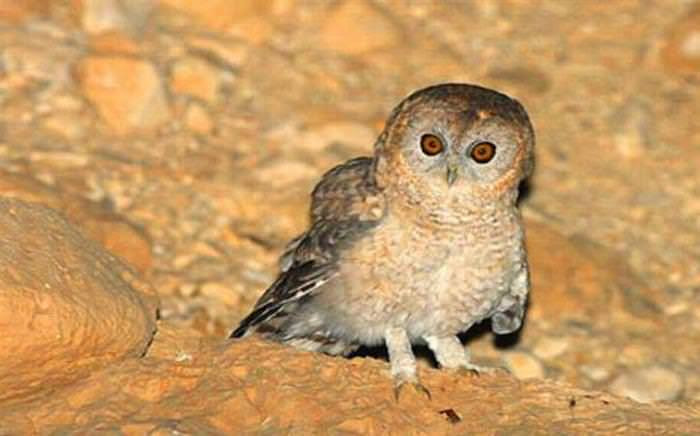
4. Cryptic Middle Eastern owl
Scientific name: Strix hadaromi
The Desert Tawny owl lives in the deserts of Israel, Egypt, Saudi Arabia, Jordan, Oman and Yemen. This cryptic species was described by a team of ornithologists in Bern, Switzerland, led by Dr. Manuel Schweizer.The scientific name pays respect to Israeli ornithologist Hadoram Shirihai. 
5. Atlantic Coast Leopard Frog: the coughing frog
Scientific Name: Rana kauffeldi
This American frog, found in the north east extending from Connecticut until North Carolina, is distinctive for its cough-sounding croak. This frog is 2 ¼ to 2 ¾ inches big and was named in honour of Carl Kauffield, an amphibian expert, who suggested the small frog existed in 1937.
6. Meet the Olinguito
This carnivorous mammal belongs to the raccoon family and looks like a teddy bear crossed with a slinky cat. The olinguito is a secretive animal who lives in the trees of Andes mountain forests, in Colombia and Ecuador. This discovery is quite a find for the scientific community: the olinguito is the first new carnivorous mammal discovered in the Western Hemisphere in the last 35 years. 
7. A spelunking snail
Scientific name: Zospeum tholussum
Technically this small snail was discovered at the end of 2013 however, the scientific community only made headways about its habits in 2014. This 2 mm tall snail is transparent with a dome-like shell and was found down a 3000-feet (914 meter) cave in Croatia. It is believed to only move a few millimeters per week, breaking land-creep records.
8. Malagasy gecko 
Scientific name: Paroedura hordiesi
This nocturnal gecko was discovered in northern Madagascar hiding out in an old French fort. A similar species was detected in 2004, but new genetic analysis shows that this gecko species is distinctive. This gecko has adapted well to its surroundings and masterfully camouflages itself among the fortress’ ruins. 
9. Antarctica has life
Researchers discovered something amazing during a trip to the icy shores of Antarctica: that there is life inside the ice. The Edwardsiella andrillae, a new form of sea anemone, thrives in extremely cold climates and loves living inside the sea ice. 
10. Australian humpback dolphins
Scientific name: Sousa Sahulensis
There are Sousa humpback dolphins along the coasts of Africa and Asia but only recently have scientists determined that the Sousa dolphins off the coast of Australia are a separate species. ‘Sahulensis’ is named after the Sahul Shelf, between northern Australia and southern New Guinea where the dolphins live. 

Wednesday, April 8, 2015

23 Rare and Stunning Butterfly SpeciesThat May Soon Become Extinct

Butterflies are some of the most beautiful creatures to look at in all of nature. They bring a certain sense of peace and harmony to any given surrounding. 
The butterflies seen here are extremely rare and placed high atop the endangered species list. It would be a real shame to lose them, especially after you see just how beautiful they are. Here are 23 gorgeous and exotic butterflies that might someday become extinct:
1) The Monarch
The orange and black Monarch is a North American native that begins its migration to Mexico for the winter. The Monarch has quite a journey too, spanning between 1,200 to 2,800 miles (1,931 km to 4,506 km). There are about 33 million Monarchs remaining in existence today. 
2) Sapho Longwing
This gorgeous light blue and white butterfly is a native of Costa Rica and certain rainforests in Belize. Sapho Longwings differ from other butterfly species in that they only breed on one specific plant. 
3) Blue Morpho
Blue Morphos are very easy to spot, since their enormous bright blue wings stretch nearly 8 inches across (20 cm) in size. They appear almost invisible when they take off, due to their dark brown and bright blue colors intertwining together. 
4) Question Mark Butterfly
This beautiful butterfly can be found in North America. They mainly reside in wooded areas and city parks, or generally in areas that have trees and free spaces. The adult butterfly has a wingspan of 4.5–7.6 cm. 
5) Mitchell's Satyr
Neonympha mitchellii is an endangered species of nymphalid butterfly of the eastern United States. 
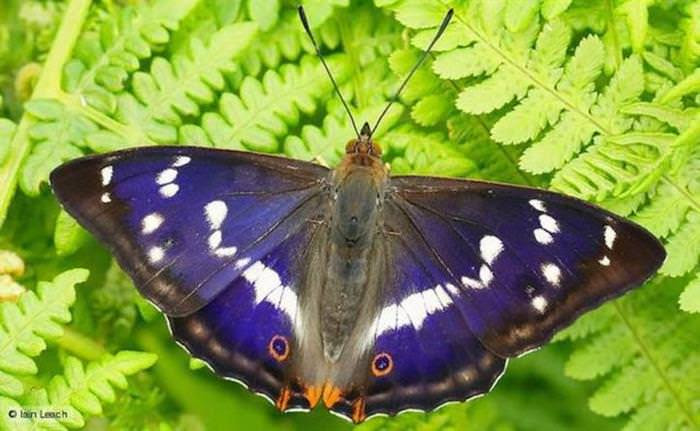
6) Purple Emperor
The Purple Emperor (Apatura iris) butterfly is Eurasian. Adults can be identified by their dark brown wings with white bands and spots and an orange ring on each of the hindwings. Males usually have a wingspan of about 70–80mm (2.8–3.1 inches), and have an purple-blue sheen that the slightly larger (80–92mm) females do not. 
7) Banded Peacock
The Banded Peacock is a South Asian native, seen mostly throughout parts of India, Sri Lanka, and Pakistan. The lime green and dark black colors easily distinguish them apart from other species. 
8) Ceylon Rose
The Ceylon Rose, sometimes Sri Lankan Rose (Pachliopta jophon) is a butterfly found in Sri Lanka that belongs to the Swallowtail family. It was earlier classified as a subspecies of Crimson Rose. It is critically endangered, declining due to loss of habitat. 
9) Chimaera Birdwing
The Chimaera Birdwing (Ornithoptera chimaera) is a birdwing butterfly of the papilionidae family. It is found in mountain areas of New Guinea, in heights of 1,000 meters above sea level.
10) Bhutan Glory
The Bhutan Glory is a species of swallowtail butterfly that is found in Bhutan, parts of northeastern India and of Southeast Asia. A spectacular insect much sought after by collectors, which has contributed to its rarity...
11) Schaus Swallowtail
Schaus' swallowtail or the island swallowtail is a species of American butterfly. It can be found in southern Florida, while subspecies have been seen in the Bahamas, Hispaniola, and Cuba. This butterfly is an extremely endangered species, with only a few hundred individuals left. In fact, it was one of the first insects to gain federal protection in 1978.
12) Saturn Butterfly
This butterfly has a wingspan of about 3.9-4.3 inches (10-11 cm). It can be found in shady forest areas. The male (shown above) is darker than the female. It is mostly found in Malaysia, Borneo, the Philippines, Myanmar and Sumatra.
13) Jamaican Giant Swallowtail
The Swallowtail is one of the largest butterfly species throughout North and South America. They can grow up to 6 inches (15 cm) across with yellow and dark blue bands. They live in remote habitats throughout the island of Jamaica. 
14) Luzon Peacock Swallowtail
Luzon Peacock Swallowtails were originally discovered in the Philippines around 1965. They have a wingspan of over 4 inches (10 cm) and have been listed as an endangered species since 1996.
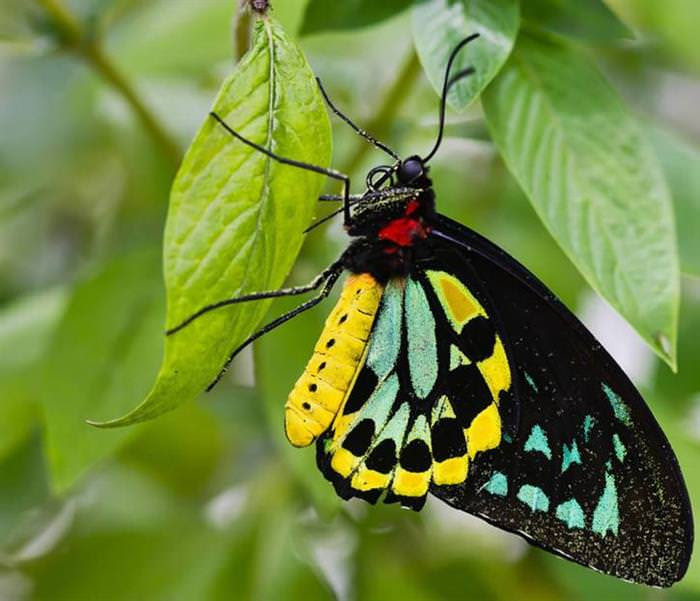
15) Richmond Birdwing
The beautifully colored Richmond Birdwing makes its home in the land down under. The native Australian species were plagued with habitat destruction and drought throughout the years. 
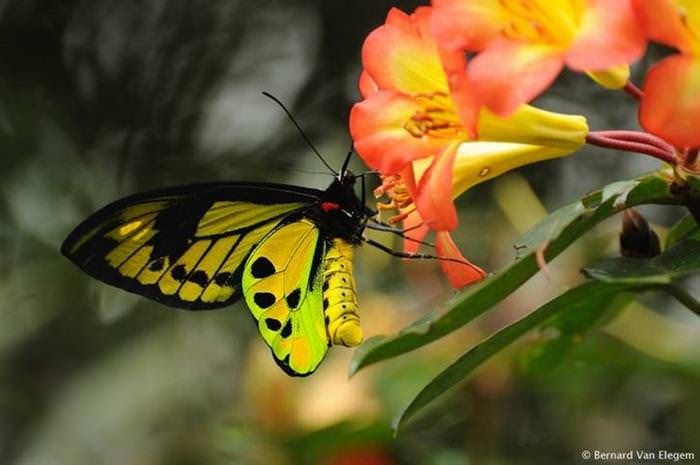
16) Wallace's Golden Birdwing
The Wallace's Golden Birdwing can only be seen in northern Maluku, Indonesia. The male has black wings with a yellow costal band. The females are larger than the males, with brown wings marked with yellow lines.
17) Island Marble
This butterfly appeared after 100 years of everyone certain it was extinct. It turned up on San Juan island in 1998. Efforts are ongoing to protect this rare butterfly.
18) Golden Kaiser-i-Hind
The lime green and gold colors give the Golden Kaiser-i-Hind its name. They are native to the Papilionidae family, and can be found in certain Asian countries, such as China and Vietnam. 
19) Spicebush Swallowtail
The spicebush swallowtail gets its name from the plant it frequents the most - the spicebush. The Spicebush Swallowtails belong to a family of the largest butterflies in the world. They are unique in that even while feeding, they continue to flutter their wings. Un many other butterflies of their family, Spicebushes butterflies fly low to the ground instead of at great heights. 
20) Glasswinged Butterfly 
This beautiful butterfly, named 'Greta oto' but nicknamed the 'glass butterfly' opens to each side 6 cm of incredibly beautiful, and completely transparent, wings. A close look at the glass butterfly's wings will show you that through the veins running across its wings, you can see a perfect image. Adults glass butterflies also exhibit a number of interesting behaviours, such as long migrations. 
21) Banded Orange Tiger 
The Banded Orange Heliconian is native to South and Central America, ranging from Brazil to central Mexico. However, in the summer it has been seen as far north as Kansas in the United States. Its wingspan ranges from 86 to 89 mm, and it is colored a bright orange with thick black stripes in males, and a duller orange with fuzzier black stripes in females.
22) Palos Verdes Blue
The chances of spotting the Palos Verdes Blue are quite slim, since they are considered to be the rarest species of butterfly in existence. There are less than several of them hundred throughout the world. 
23) Common Buckeye